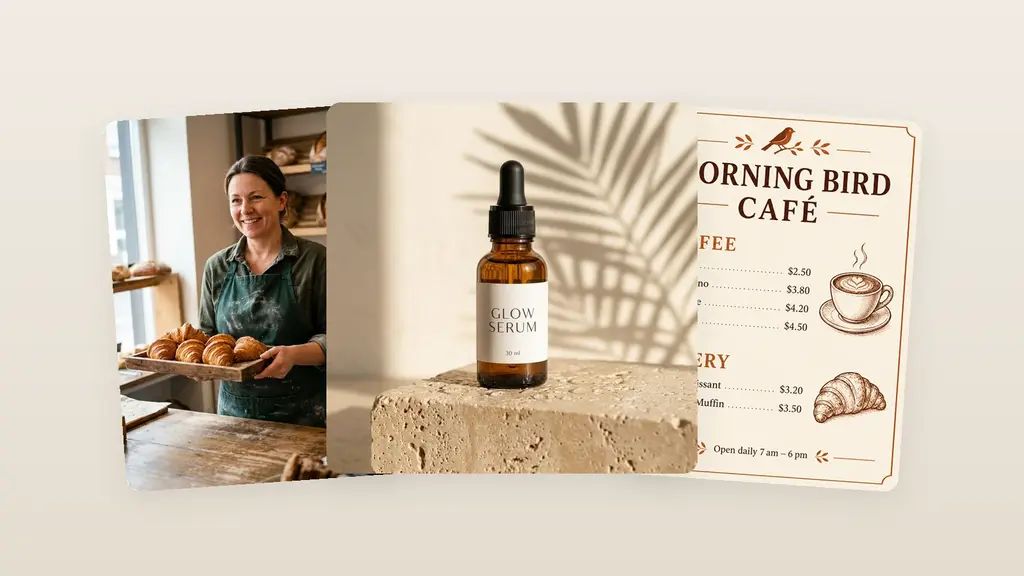
Nano Banana Pro vs Nano Banana 2, in short: in our five business tests the cheaper Nano Banana 2 matched Pro on product shots, portraits and text. GPT Image 2.5 by OpenAI made the most polished ad layouts but was the slowest of the three. Below you’ll find the same five prompts run through each model, with every result side by side.
All three models sit in one generator. Both Nano Banana models from Google and GPT Image from OpenAI are built into Turbologo’s AI design generator, so you can run one prompt through each model and compare, as we did here.
Nano Banana Pro, Nano Banana 2 and GPT Image 2.5 at a glance
| Nano Banana Pro | Nano Banana 2 | GPT Image 2.5 | |
|---|---|---|---|
| Made by | OpenAI | ||
| Released | November 20, 2025 (preview), generally available May 28, 2026 | February 26, 2026 (preview); version 2.1 on October 6, 2026 | September 8, 2026 |
| What the maker says it’s for | The most complex tasks: world knowledge, localization, brand consistency, fine creative control | Fast, efficient everyday generation; 2.1 adds better quality and text rendering | Flare, the default version: “fastest model for high-quality, everyday image generation” |
| Price in Turbologo | The most expensive of the three | The cheapest | In between, same as GPT Image 2 |
| Aspect ratios in Turbologo | 10, from 1:1 and 4:5 to 21:9 | 10, the same set | 8: no 4:5 or 5:4 |
| Quality | 1K, 2K, 4K | 1K, 2K, 4K | 1K, 2K, 4K |
A note on names. Google released Nano Banana 2.1 on October 6, 2026, marked Nano Banana 2 as deprecated and now recommends 2.1 for new projects. In the Turbologo generator the Nano Banana 2 slot already runs version 2.1 (it’s labeled that way in the model list), so 2.1 is what we tested. On the comparison images it’s signed “Nano Banana 2 (2.1)”.
Nano Banana Pro is Google’s Gemini 3 Pro Image. When Google introduced it, the company called it “the best model for creating images with correctly rendered and legible text directly in the image”, in multiple languages.
How we tested
- Same prompt, same size. Each of the five prompts went to all three models with the same aspect ratio and 1K quality.
- One attempt per model. No cherry-picking: you see the first result each model returned.
- The models as they are. We used the same model versions and the same API provider that power Turbologo’s generator, on October 16, 2026, and sent the prompts as written. In the generator itself, your prompt gets extra instructions on design and on the language of the text, so results there look more like finished layouts.
- What we compared: text accuracy, realism, prompt following, details. We also timed each image.
The five tasks are typical for a small business: a social post with text, a sale banner, a product photo, a portrait and a menu. All five prompts are in English. A prompt is simply the text description of what you want to get.
The prompt asked for a square coffee shop post with three lines written exactly as given, over a paper cup on a wooden counter in warm morning light.
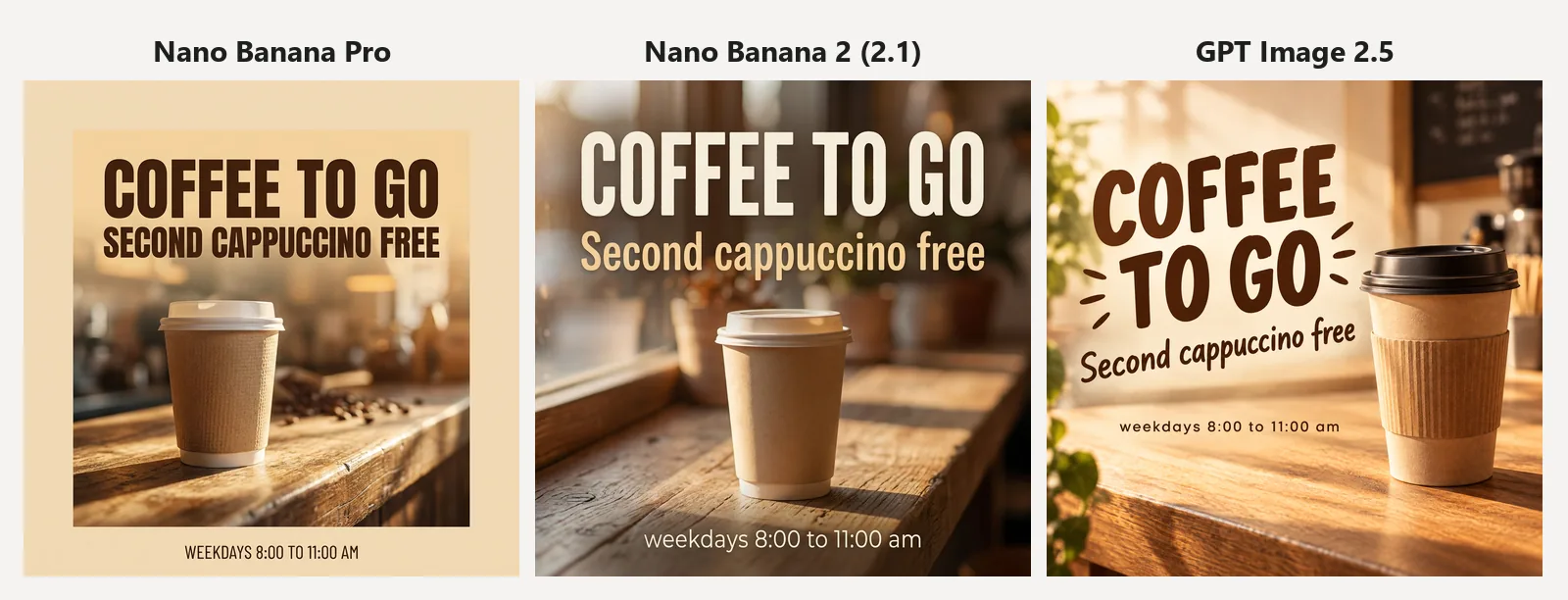
- Nano Banana Pro spelled all three lines correctly but set them all in capitals, although the prompt had the second and third lines in lowercase. It also framed the photo as a card on a beige background.
- Nano Banana 2 wrote all three lines exactly as given, right over the photo, with the cleanest type.
- GPT Image 2.5 got every line right too and made the most “designed” version: a hand-lettered headline with small accent strokes. The bottom line came out small.
Takeaway: all three models spelled short text correctly, and Nano Banana Pro took the most liberties with letter case and layout. If your text isn’t in English, end the prompt with a line like “All text on the image must be in Spanish” (or German, French and so on): without it, Nano Banana Pro may translate the wording into English. Turbologo’s generator adds this instruction for you.
Two more tips for any model. A model may carry the quotation marks around your wording onto the image, so write the text after a colon (Headline: COFFEE TO GO) or check the result. And check the spelling letter by letter: a typo can be fixed with an edit in plain words.
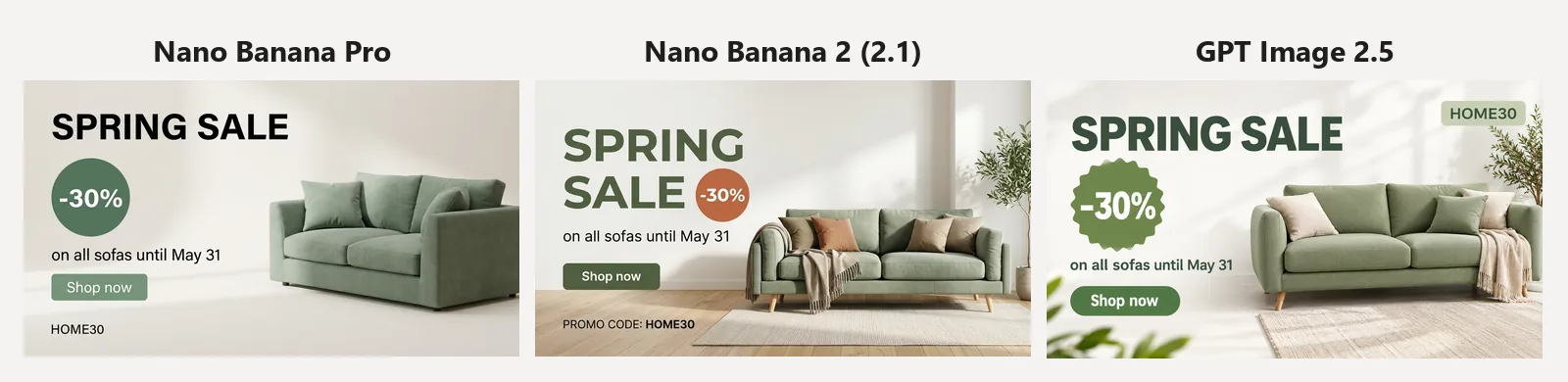
All three models spelled every line correctly. The difference is in layout and in how literally they read the prompt.
- Nano Banana Pro was the most literal and the plainest: text on the left, sofa on the right, the promo code as plain text at the bottom.
- Nano Banana 2 built the richest room (a rug, a plant, a throw) and a contrasting orange badge, but it added the words “PROMO CODE:” even though the prompt said “nothing else”.
- GPT Image 2.5 produced the most finished-looking ad: a scalloped badge, a rounded button and the promo code in a pill in the top-right corner. It was the only one to clearly put the code “in the corner”. The sofa is slightly cut off at the right edge.
Test 3: product photo on a background
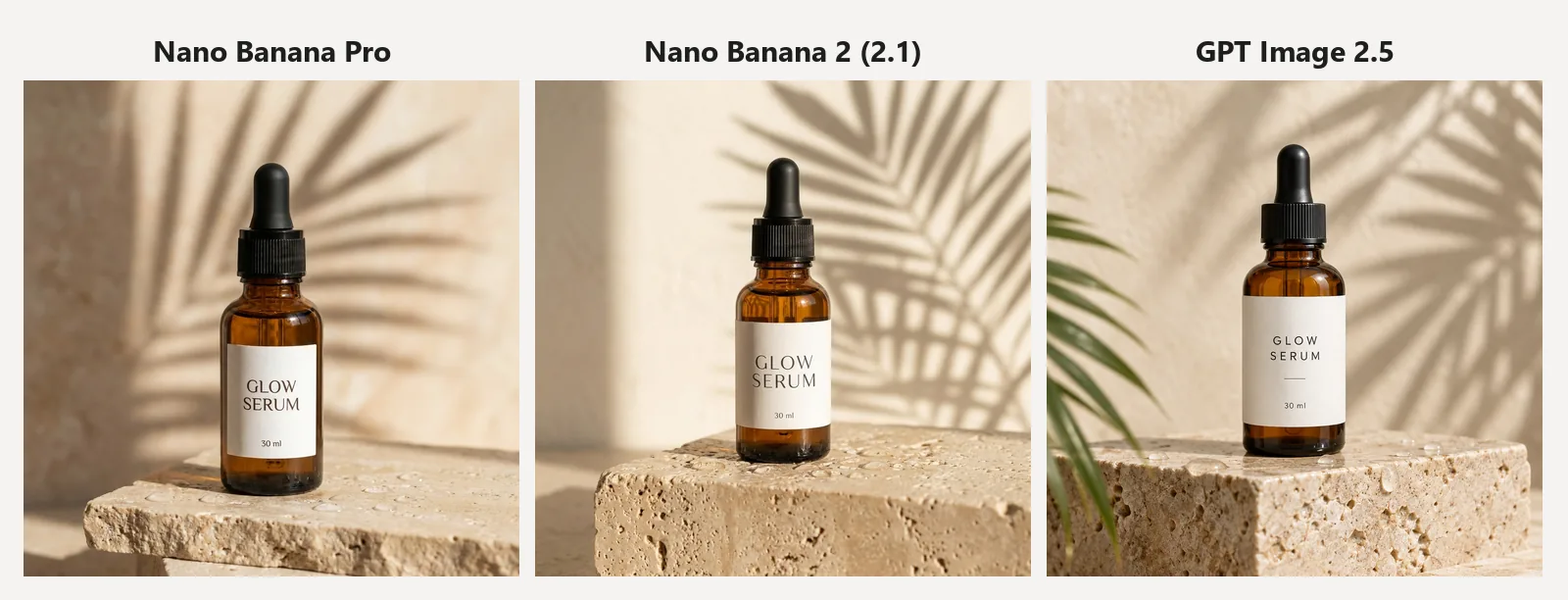
This one is close to a tie. All three printed “GLOW SERUM” and “30 ml” correctly, placed water drops on porous travertine and cast palm shadows on the wall. Nano Banana Pro and Nano Banana 2 even chose almost the same composition. GPT Image 2.5 added a real palm leaf in the foreground (the prompt asked only for shadows) and a thin line on the label.
For a product shot on a styled background, the cheapest model did the job as well as the most expensive one.
Test 4: photo-style portrait
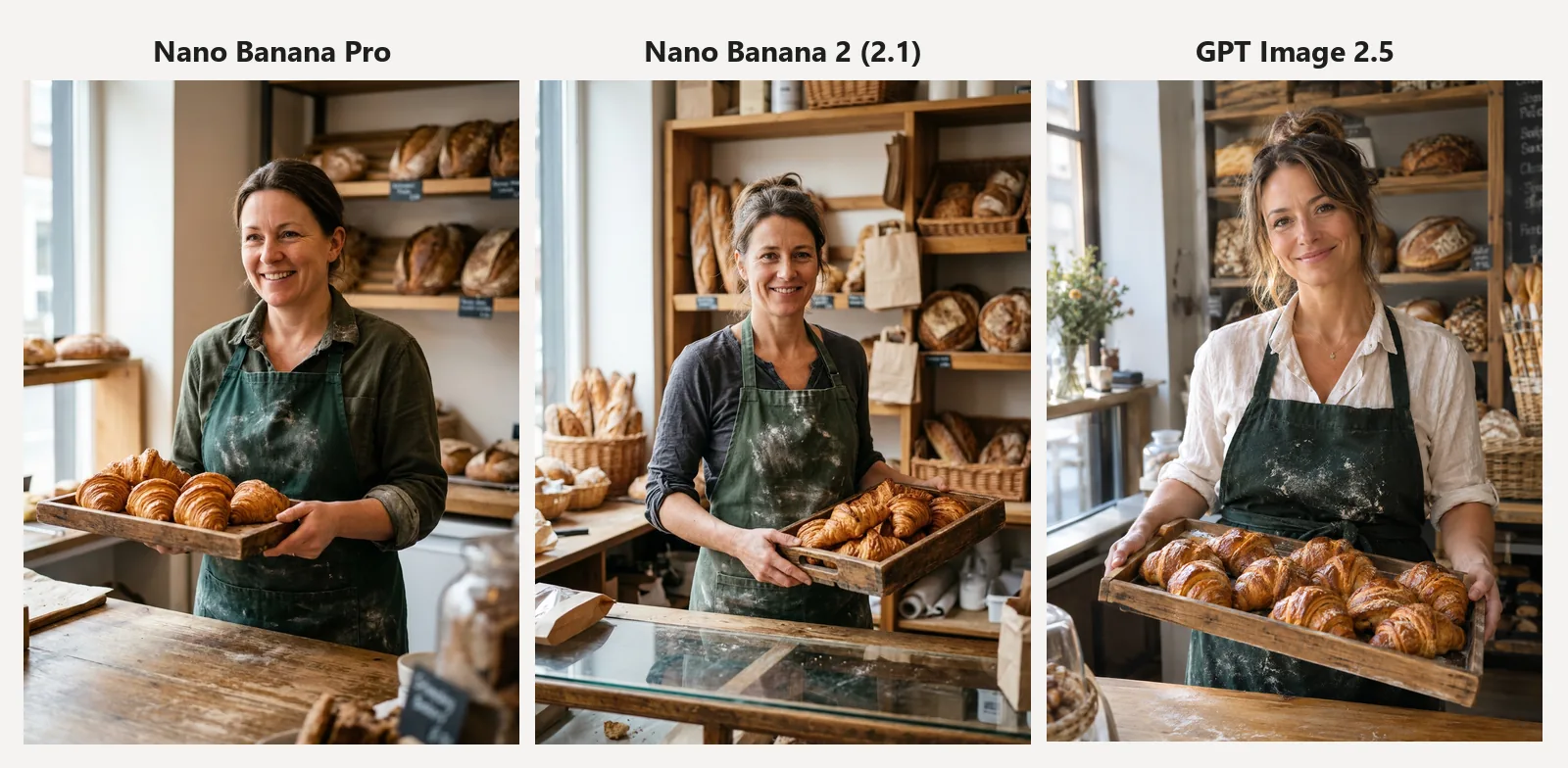
At first glance all three pass for photos: natural skin, flour on the apron, believable hands on the tray, window light from the left.
- Nano Banana Pro gave the most candid, documentary look, but the woman smiles past the camera, while the prompt asked her to smile at it.
- Nano Banana 2 followed the prompt and looks like a natural candid shot.
- GPT Image 2.5 made the glossiest, most “stock photo” version: sharper, warmer, with a fuller tray.
These are generated people, not photos of real ones. If you want an image based on a real person, upload only your own photo or a photo of someone who agreed to it. Likeness isn’t guaranteed with any model.
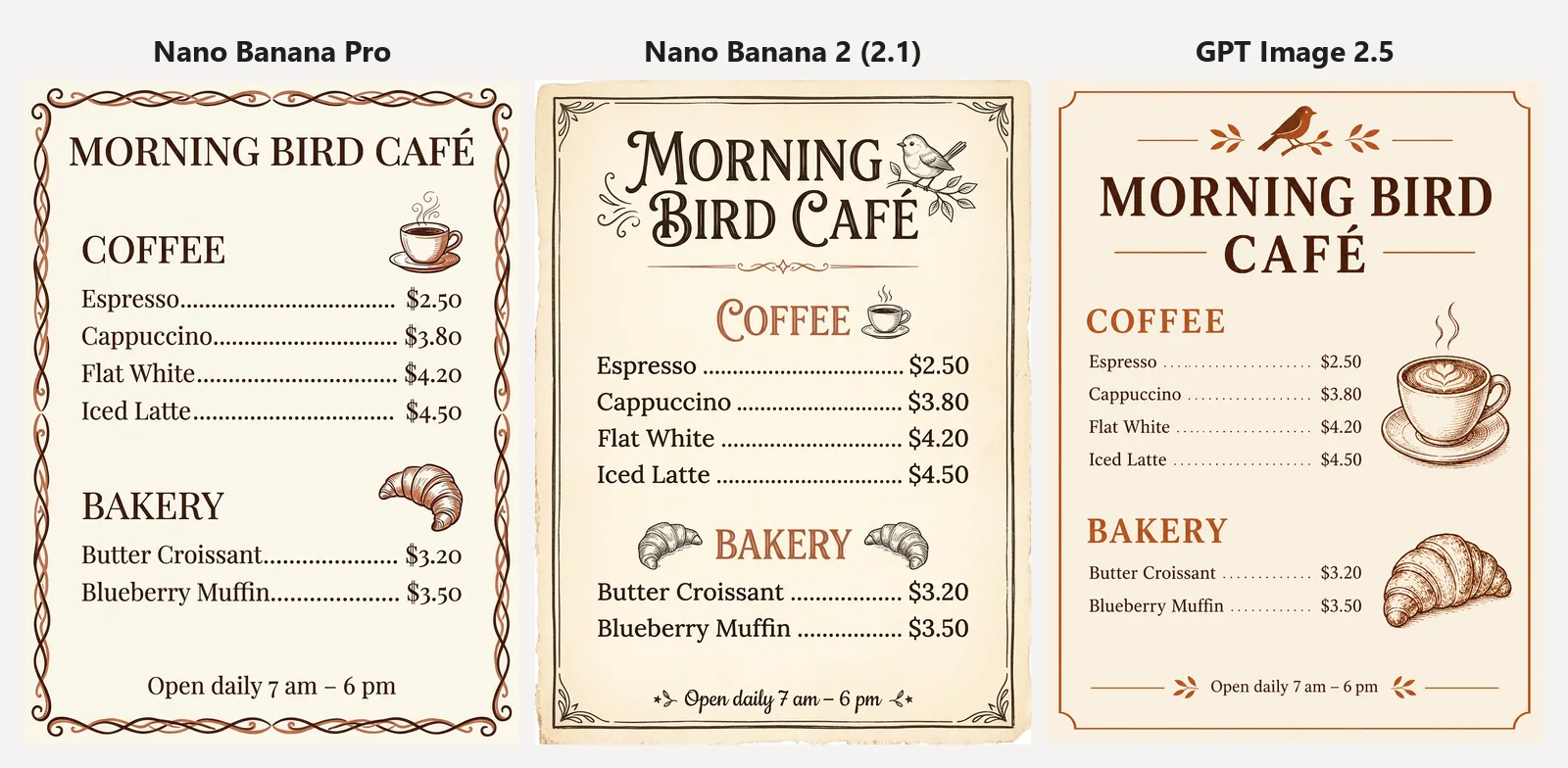
All three wrote every item, every price and the footer without a typo.
- Nano Banana Pro: the plainest layout with an ornate border; terracotta appears only in the frame.
- Nano Banana 2: the most decorative, on aged paper, plus a bird drawing that wasn’t in the prompt but suits the café’s name.
- GPT Image 2.5: the cleanest, with terracotta headings. It also added a bird.
Results: which model to use for which task
| Task | Our pick | Why, based on our tests |
|---|---|---|
| Social posts with text | Nano Banana 2 or GPT Image 2.5 | All three spelled the text correctly; Nano Banana 2 kept it exactly as written, GPT Image 2.5 made the most designed layout |
| Ad banners with English text | GPT Image 2.5 | All three spelled correctly; GPT Image 2.5 gave the most finished ad and added no extra words |
| Product photos | Nano Banana 2 | A near tie with the other two, and it’s the cheapest |
| Photo-style portraits | Nano Banana 2 for a natural look, GPT Image 2.5 for a polished one | All three looked real; Pro ignored “smiles at the camera” |
| Menus and price lists | Any of the three | Every item and price came out right in all three |
| Lots of variations on a budget | Nano Banana 2 | The cheapest and among the fastest |
| Complex scenes, many reference images, strict brand consistency | Try Nano Banana Pro | That’s what Google built it for; our five tasks didn’t test it |
Speed: in our run, both Nano Banana models returned each image in 30–41 seconds. GPT Image 2.5 took from 35 to 106 seconds per image. That is one run through one provider, and times change with load.
The honest verdict: for everyday small-business visuals, Nano Banana 2 is the best place to start. It handled every task and costs the least. GPT Image 2.5 is the one to pick when you want an ad that looks finished straight away. Nano Banana Pro handled every task too, but in these five tasks it never clearly beat the much cheaper Nano Banana 2.
Nano Banana Pro vs Nano Banana 2: what’s the difference
Both come from Google. Nano Banana Pro (Gemini 3 Pro Image) is the premium model: Google positions it for the most complex tasks, with the most world knowledge, advanced localization, brand consistency and fine creative control. Nano Banana 2 (Gemini 3.1 Flash Image) is the efficient one: fast and much cheaper. Its October update, 2.1, improves visual quality, text rendering and consistency across edits, according to Google.
In Turbologo the two differ in three ways:
- Price. Pro uses the most credits of any model in this test, Nano Banana 2 the fewest. The price calculator on the Nano Banana page shows the exact numbers.
- Speed. In our run they were about equally fast.
- Result. On our five tasks the quality was about the same. Nano Banana 2 kept the post text exactly as written, while Pro changed the letter case. Pro, in turn, followed the banner prompt more literally than Nano Banana 2.
So which is better, Nano Banana Pro or Nano Banana 2? For posts, banners, product shots and menus, start with Nano Banana 2. Move to Pro when the task is genuinely complex (a busy scene, several products or people that must stay consistent, many reference images), and try it on one image at 1K before you make a batch.
GPT Image 2 vs GPT Image 2.5: which GPT Image to pick
OpenAI released GPT Image 2 on April 21, 2026, and GPT Image 2.5 on September 8, 2026. Version 2.5 comes in two variants. OpenAI describes Flare as its “fastest model for high-quality, everyday image generation” and Sunburst as its “most capable model for image generation and editing”, meant for “workflows where editing precision matters most”.
In Turbologo all three are in the model list, and GPT Image 2.5 (Flare) is the default:
- GPT Image 2.5 (Flare): the one we tested. A good default for posts and ads.
- GPT Image 2.5 Sunburst: for precise edits, takes longer per image.
- GPT Image 2: the previous version, with fewer aspect ratios: 1:1, 9:16, 16:9, 4:3 and 3:4. Version 2.5 adds 3:2, 2:3 and 21:9.
All three use the same number of credits, so there’s little reason to pick GPT Image 2 for new work. Flare vs Sunburst in one line: use Flare to create, and try Sunburst when an edit must change exactly one thing and leave the rest alone.
Nano Banana vs ChatGPT and Midjourney
ChatGPT creates images with OpenAI’s own GPT Image models (ChatGPT Images 2.5 since September 8, 2026). So “Nano Banana vs ChatGPT” is mostly Nano Banana vs GPT Image, and the tests above answer it. The bigger difference is the workflow: a chat versus a generator that knows your logo, brand colors and platform sizes. More on that in Turbologo or ChatGPT for business design.
Midjourney is a separate service with its own subscription. It isn’t part of Turbologo’s generator, and we didn’t test it here.
How to try all three in Turbologo
- Open the generator and sign in. In most countries, signing up gives you credits for one generation on the default model at 1K.
- Describe the task. Write the exact wording, for example after a colon, and name the format, for example “a square post” or “a vertical 9:16 story”. You can attach your logo and sample images, up to 10 in total.
- Pick the model and size. Choose Nano Banana 2, Nano Banana Pro or GPT Image in the model list, then the aspect ratio and 1K, 2K or 4K quality.
- Compare and refine. Run the same prompt on another model, or fix the result with an edit in plain words: “make the background darker”, “fix the spelling in the headline”. The result is a finished image, so changes are made with these edits, and each one uses credits.
For prompt ideas, see our Nano Banana guide and how to generate an image with AI.
In our five tests (a post, a banner, a product photo, a portrait and a menu) Nano Banana 2 did as well as Pro and costs less. Start with Nano Banana 2 and use Pro for complex scenes with many references.
Nano Banana is the name of Google’s family of image models. The original Nano Banana (Gemini 2.5 Flash Image) is now a legacy model. Nano Banana Pro (Gemini 3 Pro Image) is the premium one for complex tasks, and Nano Banana 2 (now 2.1) is the fast, efficient one.
We tested GPT Image 2.5, the successor of GPT Image 2 at the same price in Turbologo. With English text, all three models (Nano Banana Pro, Nano Banana 2 and GPT Image 2.5) spelled every line correctly, including a six-item menu. If your text isn’t in English, name the language in the prompt: Turbologo’s generator does this for you.
ChatGPT draws with OpenAI’s GPT Image models, so compare Nano Banana with GPT Image. In our tests Nano Banana 2 was faster and cheaper, and GPT Image 2.5 made more polished ad layouts. Both are available in Turbologo’s generator.
GPT Image 2.5. In Turbologo it costs the same as GPT Image 2 and supports more aspect ratios. Flare, the default, is for everyday generation; Sunburst is for precise edits and takes longer.
Midjourney is a separate service with its own subscription, and it isn’t part of this test or of Turbologo’s generator.